How to Build an Email List While Working Full-Time - Your 9-to-5 Exit Plan Starts Here
If you're still in a 9-to-5 job, one of the smartest decisions you can make right now is to build an email list — before you ever leave.
Not a social media following. Not daily posts that disappear in 24 hours. An email list.
An email list is the foundation of a sustainable online business. More specifically, it's one of the most powerful tools you can use to build income before retirement — not after. And the good news is that you can build one consistently while working full time, without burnout, without complicated technology, and without sacrificing your career or your family.
This guide walks you through how to do exactly that — step by step.
Why Email Marketing Is the Right Strategy When You Still Have a Job
When you're employed full time, time is your most limited resource. You need a strategy that works quietly in the background — one that doesn't demand your constant attention to keep moving.
That's what email marketing does. It lets you:
- Own your audience — unlike social media, no algorithm can take your list away
- Build trust gradually, one email at a time
- Automate your communication so it works even while you're at the office
- Create genuine leverage without needing to post or show up every day
For anyone building an online business before retirement, email isn't optional — it's the core of everything. A well-built list of 500 genuinely interested people will outperform a social media following of 10,000 casual scrollers every single time.
Step 1: Get Clear on Who You're Helping
Before you build anything, you need to be specific about who your list is for. This is where most beginners go wrong — they try to appeal to everyone, which means they connect with no one.
The clearer your audience, the faster your list grows and the higher the quality of your subscribers. For example, if you're targeting professionals who want to build an online business before they retire, your entire message — your lead magnet, your emails, your content — should speak directly to that person.
Ask yourself: who am I talking to, what do they want, and what's stopping them from getting it? That answer shapes everything else.
Step 2: Create a Lead Magnet People Actually Want
A lead magnet is the reason someone gives you their email address. It's a free resource that solves one specific problem quickly — and makes your subscriber feel that signing up was worth it.
The best lead magnets for a professional audience building toward a 9-to-5 exit share three things: they're quick to consume, they solve an immediate problem, and they align naturally with what you'll offer later.
Some formats that work well:
- A getting-started guide (e.g. "The 9-to-5 Exit Starter Guide")
- A short email course delivered over 5–7 days
- A free workshop or training video
- A simple roadmap or checklist
A well-crafted lead magnet does something important: it filters your audience. It attracts the right people — serious professionals who are genuinely ready to change something — and it sets the tone for everything you send them afterwards.
What makes a lead magnet worth signing up for?
It must feel immediately useful. Someone should be able to consume it in 10–20 minutes and walk away with one clear, actionable next step. If your lead magnet tries to cover everything, it ends up helping no one. Pick one problem, solve it well, and leave your subscriber wanting more.
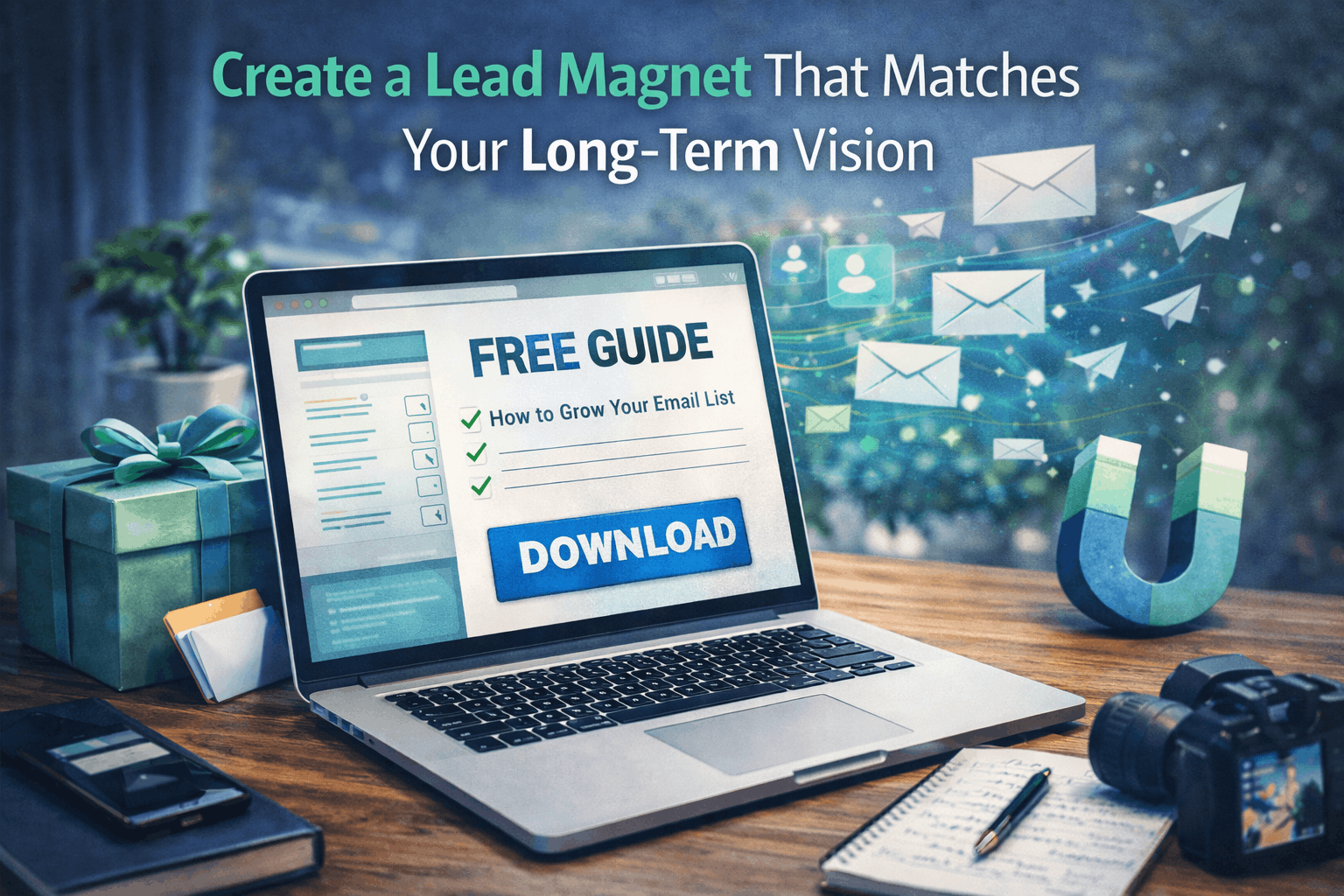
Step 3: Set Up a Simple Automated Email System
Here's a misconception worth clearing up: email marketing is not complicated. You don't need to be technical to set it up, and you don't need to understand code or design.
To get started, you need three things:
- A sign-up page — where people enter their name and email in exchange for your lead magnet
- An autoresponder — the software that stores your list and sends emails automatically
- A welcome sequence — a short series of pre-written emails that delivers your lead magnet and introduces who you are
Your initial sequence should welcome new subscribers warmly, deliver on the promise you made, introduce your story and why you're the right guide for them, and build trust before you ever mention an offer.
Once this is in place, your system runs automatically. New subscribers join, receive your welcome sequence, and start building a relationship with you — all while you're at work. That's the real power of this model.
Step 4: Drive Consistent Traffic Without Burning Out
If you're building this while employed, you can't afford to be everywhere at once. The goal is not volume — it's consistency. Focus on traffic sources that keep working long after you create them.
The most effective options for a professional building on the side:
- Blog content optimised for search — a well-written article can bring in subscribers for years
- YouTube videos — evergreen content that builds authority and trust over time
- Paid ads — once you understand your audience and have a tested offer, ads accelerate everything
- Strategic educational posts — not daily posting, but intentional content that answers real questions
One good piece of content, consistently supported, will outperform ten pieces of rushed content every time. Build slowly, build well, and the compounding effect will surprise you.
Step 5: Use Authority Marketing to Build Trust Before You Sell Anything
Authority marketing is not about presenting yourself as an expert with a long CV. It's about positioning yourself as a trustworthy guide — someone who understands where your audience is and can show them a credible path forward.
Through your emails, you can:
- Educate your subscribers on how online income actually works
- Clear up the myths and misconceptions that hold people back
- Share honest lessons from your own journey
- Help people set realistic expectations about what building online looks like
This matters especially for professionals in their 40s and 50s who are considering a career or retirement transition. They've been around long enough to spot hype. They don't want pressure — they want clarity and honesty. When you build trust through consistent, useful emails, selling becomes a natural conversation rather than a transaction.
Step 6: Keep Emailing Your List — Even When You're Not Selling
Your email list is a long-term asset, and it only stays valuable if you show up for it consistently. That means emailing your subscribers regularly — not just when you have something to sell.
Some of the most effective types of regular emails include:
- Educational content that helps subscribers understand the online business world
- Mindset emails that address the fears and doubts your audience carries
- Common mistakes to avoid when starting an online business
- Realistic stories of what the journey looks like day to day
This approach does something important: it builds a relationship rather than a transaction history. Subscribers who feel genuinely helped are far more likely to trust your recommendations when you do promote something.
How often should you email your list?
Consistency matters more than frequency. One email per week is enough to stay relevant and build real trust. Start there, get comfortable, and increase to twice a week only when you're confident in your content quality. Never sacrifice quality for volume.
Common Mistakes That Slow Down Your Progress
If you want your 9-to-5 exit plan to work, there are a few patterns worth avoiding from the start:
- Waiting until you're ready to leave your job. The best time to build your list is while you still have income coming in. Pressure is the enemy of good decisions.
- Trying too many platforms at once. Pick one traffic source, master it, then expand. Spreading thin across five channels builds nothing well.
- Selling before trust is established. Your first few emails should give value, not ask for anything. Earn the right to sell by helping first.
- Copying hype-driven tactics. Your audience has seen the flashy promises. What earns trust is honest, practical, grounded communication.
Slow, intentional progress — built on genuine connection with your audience — will always outperform rushed action driven by anxiety.
Why Starting Now Is the Smartest Move You Can Make
Many people wait until they're forced to change. The ones who retire on their own terms are the ones who started preparing years before they had to.
If retirement is 5 to 10 years away, starting your email list today gives you time to learn, test, refine, and grow. It gives you the chance to build real income options before you need them — rather than scrambling to create something under financial pressure.
Even a small, well-built list of engaged subscribers is a genuine business asset. It can generate affiliate income, support a digital product launch, or simply open doors that don't exist for people who waited.
The Tool I Use to Manage My Email List
I believe in keeping things simple — especially for professionals building an online business alongside their job.
The tool I use and recommend is AWeber,
It's beginner-friendly, reliable, and includes AI-assisted features that help with writing emails and setting up automated sequences without any technical complexity.
There are plenty of email tools available, and the differences between them matter far less than actually choosing one and starting. The most important decision is picking a platform you'll use consistently and getting your first subscribers on the list.
If you're still at the beginning of your journey, you may first want to learn how to start an online business while working a 9 to 5 which explains the foundation before building your email list.
How Email Fits Into Your Broader Online Business Plan
Building an email list is not a standalone tactic. It's the backbone of almost every successful online business model — affiliate marketing, digital education, coaching, and content-based businesses all depend on a list at their core.
When combined with good content and a simple automated system, your list allows you to build quietly and consistently — without quitting your job prematurely, without betting everything on one decision, and without the constant hustle that burns most people out before they ever see results.
It's the kind of asset that compounds over time. A list you build carefully over two years will give you more options and more security than most people imagine is possible from a 9-to-5 background.
Final Thoughts
You don't need more hustle. You need smarter systems.
If you're serious about building income before retirement, creating real options for yourself, and eventually leaving the 9-to-5 on your own terms — building your email list is one of the highest-leverage decisions you can make right now.
Start while you have the security of your current income. Build steadily. Show up for your subscribers consistently. And give yourself the options that most people only wish they'd started building sooner.
Ready to Take the First Step?
If you want to see exactly how professionals in their 40s and 50s are building online income
alongside their jobs — without quitting, without creating a product, and without daily social
media — access a free workshop video series that shows you the full picture.
It's the same model I use. It's beginner-friendly. And it works around your schedule.
Disclosure
Some links on this page may be affiliate links, which means I may earn a commission at no extra cost to you. I only recommend tools I personally use or believe provide real value for building an online business.